简介: |
Ye-Hwa Chen Professor, The George W. Woodruff School of Mechanical Engineering, Georgia Institute of Technology. Outstanding Visiting Professor, Tsinghua University. (清华大学杰出访问教授) Ye-Hwa Chen received his B.S. in Chemical Engineering from the National Taiwan University in 1979. He then received his M.S. and Ph.D. in Mechanical Engineering from the University of California, Berkeley, in 1983 and 1985, respectively. He served as a faculty in Syracuse University during 1986-1988. Since 1988, he has been with the George W. Woodruff School of Mechanical Engineering of Georgia Institute of Technology. He has been serving as regional editor and associate editor for nine journals. He has published over 220 refereed journal papers. He has received the IEEE Transactions on Fuzzy Systems Outstanding Paper Award, Sigma Xi Best Research Paper Award, and Sigma Xi Junior Faculty Award. A paper of his received the second highest citation in the IEEE Transactions on Industrial Electronics. He received the Passport Award, the Monopoly Award, and the “As Good As It Gets” Award from the Georgia Institute of Technology. He is the recipient of the Campanile Award from the Georgia Institute of Technology, the highest honor of the institute. His research interests include dynamical systems and mechatronic systems modeling and analysis, fuzzy systems, and control. The Character of Control Theory 报告语言:中文 The history of control theory dates back to the industrial revolution, when James Watt creatively figured out a feedback torque to counter balance the changes of the spinning of steam engine. This conception then evolved into classical control, followed by modern control and post-modern control. There are currently many mature control methods in place, developed by creative engineers, ranging from optimal, adaptive, robust, and intelligent emphasis. When one looks back, a natural question arise: are there any character behind the scenes? This presentation takes us through a colossal amount of control methods to return to the origin of creation. It helps us to embrace the control theory as a whole. 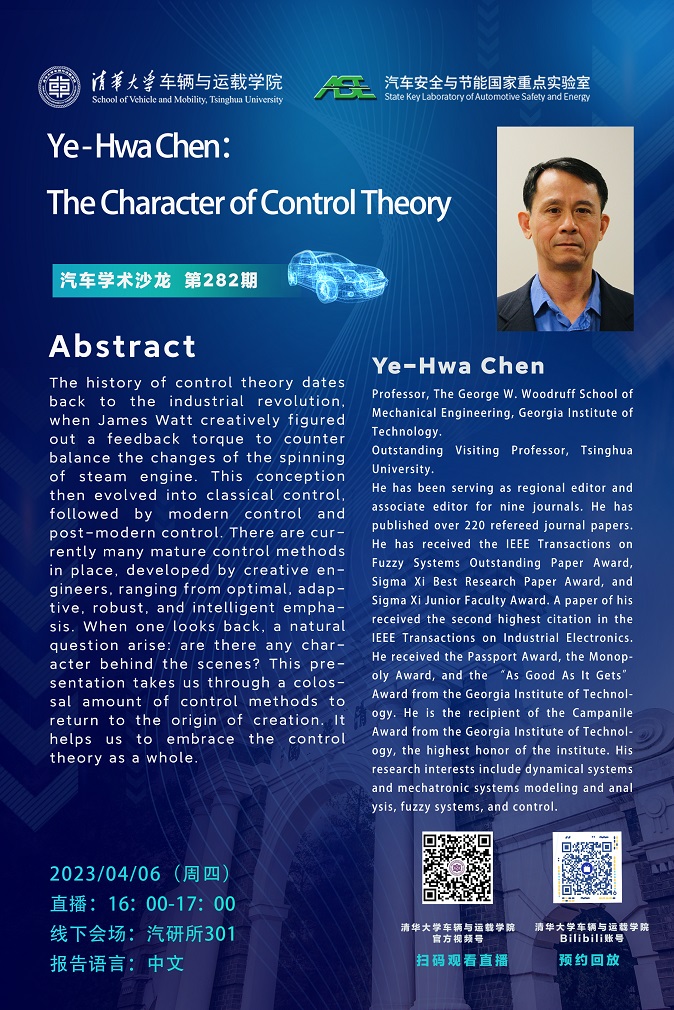
|












