简介: |
An overview of battery development at Nissan and addressing the challenges of high energy density electrochemical systems: A Material Informatics Approach 【Abstract】 Early years of Twentieth century saw the widespread adoption of automobiles that had ripple effects on every aspect of human life: from where we live, how we spend leisure activities to what is considered as resources over which we fought with each other. A century later, we are at the cusp of another revolution on what powers the automobile industry: Energy-dense Electrochemical Systems. High-Energy density batteries are being developed, both by academia & industry, to address the needs of the automobile industry. Advances in this field are currently powered by a combination of computations and experiments. In particular, Material informatics driven approaches have shortened the development cycle from decades to just a few years. In this talk, we will discuss Vision 2030 of Nissan for Zero Emission Vehicles (ZEV) and Materials Informatics approach: A combination of high-fidelity computations, Machine Learning tools and Big Data in Material Science; are used to achieve this. A broad overview of challenges that the industry is facing in developing High-Energy density batteries and examples of how Materials Informatics approach is used will be covered in this discussion. 【Resume】 Dr. Shigemasa Kuwata graduated from the Department of Chemistry, Saga University, Japan, in 1998 and received his Ph.D. degree in Inorganic Chemistry from the Department of Chemistry, University of Heidelberg, Germany, in 2005 under the supervision of Prof. Peter Comba. During his Ph.D. studies, he synthesized various new metal complexes and analyzed their catalytic activity and electrochemical properties. In 2005, he joined Nissan Research Center in Japan, where he worked on the development of materials for electrocatalysts, gas diffusion layers and seals and stack design for PEMFC (Proton-Exchange Membrane Fuel Cells). From 2013, he worked on materials research and cell design for lithium-ion and All-Solid-State Batteries (ASSB). In 2019, he moved to the US to join Nissan Advanced Technology Center, Silicon Valley to lead materials research including battery as Deputy General Manager, utilizing data-driven, materials informatics, which combines materials calculations and experimental methods. Dr Balachandran Radhakrishnan obtained his Bachelors in Mechanical Engineering degree from Anna University in 2005 followed by a Masters in Applied Mechanics from Indian Institute of Technology, Madras in 2007 where he started working on computational tools. After a few-months-stint in General Electric as a Computational Engineer, he moved to University of Michigan to pursue his PhD in the Mechanical Engineering department. He specialized in developing Multi-scale electronic structure computational tools to study defects in metals. Following this turn towards computations in Material Science, he did a Post-doc in University of California, San Diego (2014-16) under the supervision of Dr Shyue Ping Ong where he worked on using high-throughput DFT to study Li-ion & Na-ion electrochemical systems, in particular, All-Solid-State Batteries (ASSB). Following this, he went to work at NASA Ames Research Center as a Researcher (contractor) working on Li-O2 batteries while continuing to work on ASSBs as well. Since Nov 2020, he moved onto Nissan Advanced Technical Center, Silicon Valley where he & Dr Kuwata have setup a Materials Informatics group that addresses the technical challenges of automotive applications. 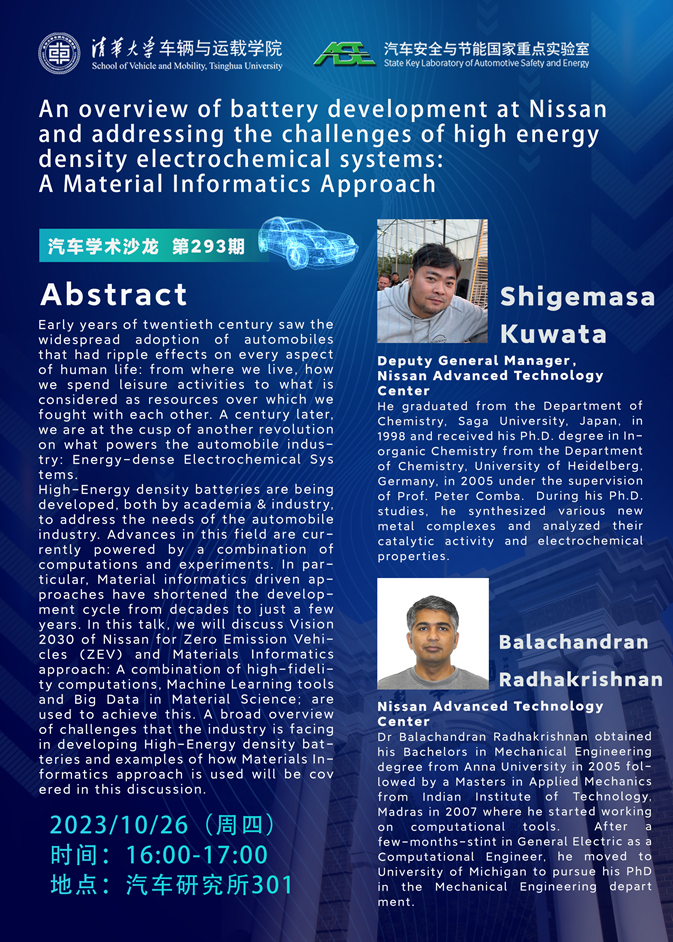
|












