简介: |
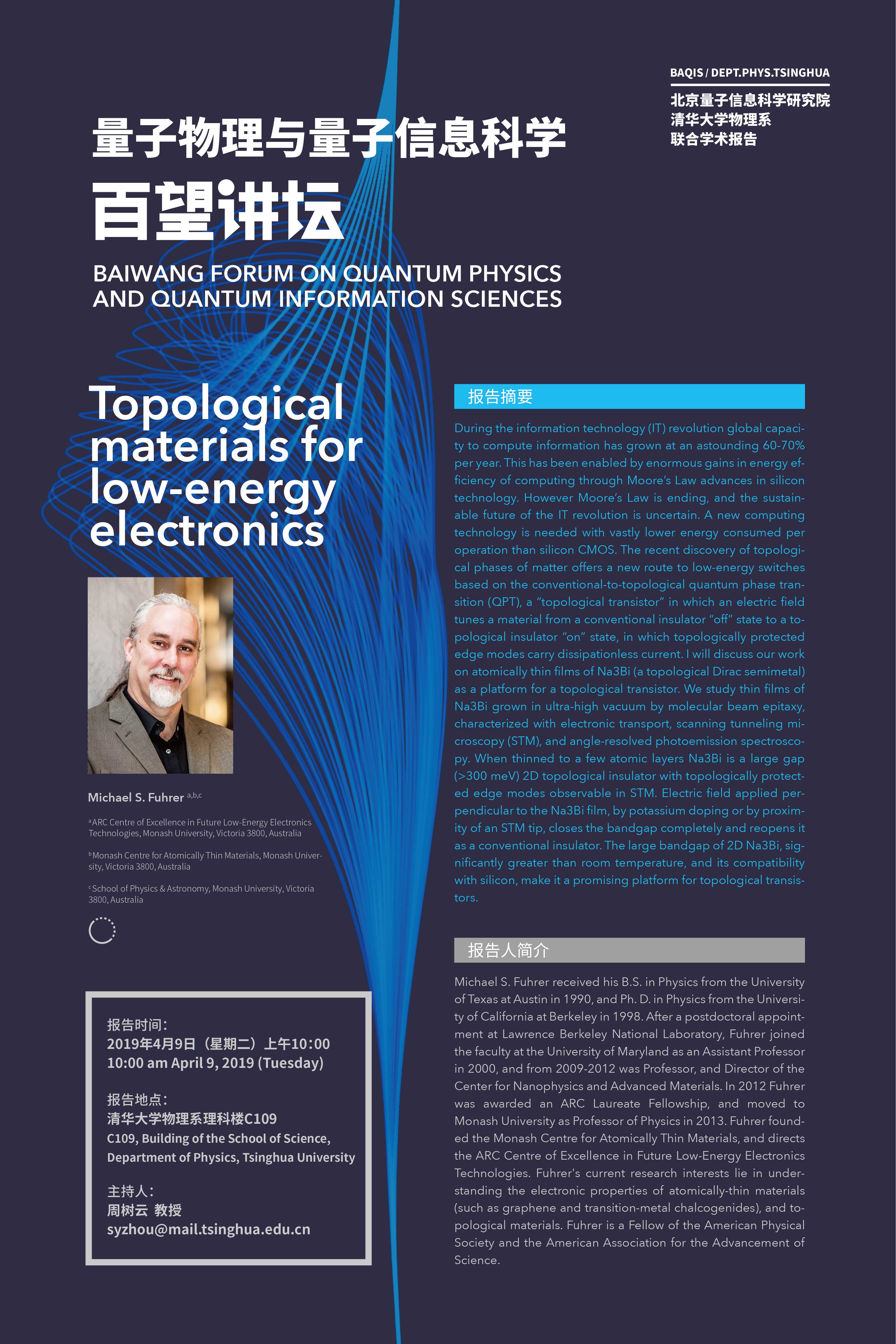
During the information technology (IT) revolution global capacity to compute information has grown at an astounding 60-70% per year. This has been enabled by enormous gains in energy efficiency of computing through Moore’s Law advances in silicon technology. However Moore’s Law is ending, and the sustainable future of the IT revolution is uncertain. A new computing technology is needed with vastly lower energy consumed per operation than silicon CMOS. The recent discovery of topological phases of matter offers a new route to low-energy switches based on the conventional-to-topological quantum phase transition (QPT), a “topological transistor” in which an electric field tunes a material from a conventional insulator “off” state to a topological insulator “on” state, in which topologically protected edge modes carry dissipationless current. I will discuss our work on atomically thin films of Na3Bi (a topological Dirac semimetal) as a platform for a topological transistor. We study thin films of Na3Bi grown in ultra-high vacuum by molecular beam epitaxy, characterized with electronic transport, scanning tunneling microscopy (STM), and angle-resolved photoemission spectroscopy. When thinned to a few atomic layers Na3Bi is a large gap (>300 meV) 2D topological insulator with topologically protected edge modes observable in STM. Electric field applied perpendicular to the Na3Bi film, by potassium doping or by proximity of an STM tip, closes the bandgap completely and reopens it as a conventional insulator. The large bandgap of 2D Na3Bi, significantly greater than room temperature, and its compatibility with silicon, make it a promising platform for topological transistors.
Biography:
Michael S. Fuhrer received his B.S. in Physics from the University of Texas at Austin in 1990, and Ph. D. in Physics from the University of California at Berkeley in 1998. After a postdoctoral appointment at Lawrence Berkeley National Laboratory, Fuhrer joined the faculty at the University of Maryland as an Assistant Professor in 2000, and from 2009-2012 was Professor, and Director of the Center for Nanophysics and Advanced Materials. In 2012 Fuhrer was awarded an ARC Laureate Fellowship, and moved to Monash University as Professor of Physics in 2013. Fuhrer founded the Monash Centre for Atomically Thin Materials, and directs the ARC Centre of Excellence in Future Low-Energy Electronics Technologies. Fuhrer's current research interests lie in understanding the electronic properties of atomically-thin materials (such as graphene and transition-metal chalcogenides), and topological materials. Fuhrer is a Fellow of the American Physical Society and the American Association for the Advancement of Science.
 百望讲坛定稿(清华版).jpg 百望讲坛定稿(清华版).jpg
|