简介: |
本次活动仅面向校内开放
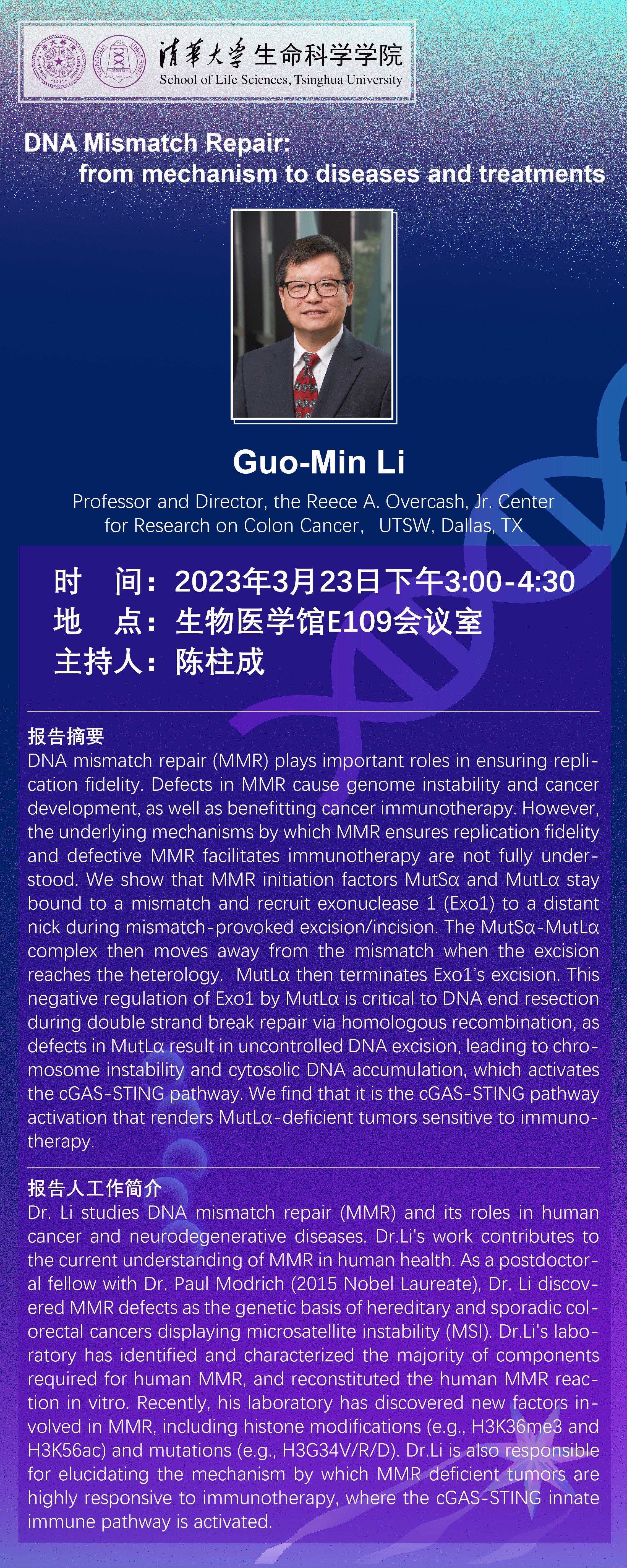
报告题目:DNA mismatch repair: from mechanisms to diseases and treatments 报告摘要:DNA mismatch repair (MMR) plays important roles in ensuring replication fidelity. Defects in MMR cause genome instability and cancer development, as well as benefitting cancer immunotherapy. However, the underlying mechanisms by which MMR ensures replication fidelity and defective MMR facilitates immunotherapy are not fully understood. We show that MMR initiation factors MutSα and MutLα stay bound to a mismatch and recruit exonuclease 1 (Exo1) to a distant nick during mismatch-provoked excision/incision. The MutSα-MutLα complex then moves away from the mismatch when the excision reaches the heterology. MutLα then terminates Exo1’s excision. This negative regulation of Exo1 by MutLα is critical to DNA end resection during double strand break repair via homologous recombination, as defects in MutLα result in uncontrolled DNA excision, leading to chromosome instability and cytosolic DNA accumulation, which activates the cGAS-STING pathway. We find that it is the cGAS-STING pathway activation that renders MutLα-deficient tumors sensitive to immunotherapy.
报告人工作简介:Dr. Li studies DNA mismatch repair (MMR) and its roles in human cancer and neurodegenerative diseases. Dr. Li’s work contributes to the current understanding of MMR in human health. As a postdoctoral fellow with Dr. Paul Modrich (2015 Nobel Laureate), Dr. Li discovered MMR defects as the genetic basis of hereditary and sporadic colorectal cancers displaying microsatellite instability (MSI). Dr. Li’s laboratory has identified and characterized the majority of components required for human MMR, and reconstituted the human MMR reaction in vitro. Recently, his laboratory has discovered new factors involved in MMR, including histone modifications (e.g., H3K36me3 and H3K56ac) and mutations (e.g., H3G34V/R/D). Dr. Li is also responsible for elucidating the mechanism by which MMR deficient tumors are highly responsive to immunotherapy, where the cGAS-STING innate immune pathway is activated.
|












