Mehdi Vahdati 简介 Mehdi Vahdati教授是英国帝国理工大学机械工程系的首席研究员,叶轮机械行业顶级期刊ASME J.Turbomachinery副主编,Rolls-Royce公司Research Fellow。 他的研究聚焦于航空叶轮机械流固耦合数值算法,航空发动机风扇叶片颤振仿真,旋转失速和喘振模拟,涡轮和压气机叶片强迫振动预测以及数据驱动的气弹和气动声学现象等,在风扇失速颤振方面做出众多原创性成果,包括首次发现了进气道声颤振现象,并提出了系统性的解决方案。Mehdi Vahdati教授目前发表期刊学术论文90余篇,并于2001年荣获世界知名航空发动机公司Rolls-Royce公司授予的Research Fellow头衔,为Rolls-Royce公司节约研发经费上亿英镑。 Data-Driven Modelling of Aerodynamic and aeroelastic instabilities of fans (数据驱动的航空发动机风扇气动和气弹失稳建模) Accurate evaluation of stall and flutter boundary is crucial in design of aeroengines. Aerodynamic and aeroelastic design of modern fans in turbomachines is conducted by simplified simulations and design rules resulting from years of experience; verification and certification are based on experimental testing and computational fluid dynamics (CFD) simulations. However, current engine designs have approached their limit in efficiency and noise, and to achieve significant improvements new design concepts are required . The rules for aerodynamic and aeroelastic stability do not exist for these new design concepts, and hence, the role of simulations is now more relevant than ever as engine/rig test are very expensive especially in case of failure. The increase in computing power has enabled the use large scale CFD models, but large scale CFD computations require a significant amount of computational time and cannot be used during design. Moreover, CFD methods require the modelling of turbulence which can be a key driver for accurate modelling of instabilities. In the past few years, there has been a fruitful increase in the use of Machine Learning (ML) approaches toward forecasting unsteady turbulent fluid flows. However, the ML models which are created solely from data (referred to as ‘black-box’ models) are not suitable for stall prediction due to amount of data required for training such models to a satisfactory accuracy level. Due to shortcomings of black-box models for complex science and engineering problems, there is a growing movement towards methodologies that integrate traditional physics-based models with machine learning (ML) techniques. In this presentation the application of such an approach for evaluating the stall and flutter boundary is explored and following areas are explored: • Turbulence modelling • Flutter and stall predictions 在航空发动机设计中准确评估失速和颤振边界至关重要。现代风扇的空气动力学和气动弹性设计流程是先依据简化模拟和长期总结的设计准则进行设计,随后通过验实验测试和CFD模拟进行验证。然而,当前的发动机设计已接近其效率和噪声的极限,未来发动机的重大突破将依靠新的设计理念。在这些新设计理念下,传统的空气动力学和气动弹性稳定性准则将不再适用。同时,整机或部件实验成本高昂,且易发生事故。因此,在新设计理念下,仿真成为重要的研究手段。 虽然,大规模CFD计算近年来得到大量应用,但仍耗时巨大而不适合在设计阶段使用。此外,在CFD方法中,湍流模型极大的影响了失稳预测的准确性,是误差的重要来源。 近年来,机器学习 (ML) 方法在预测非定常的湍流流动方面得到了成功应用,并取得了丰硕的成果。然而,单纯数据驱动的ML模型(“黑盒”模型)却并不适合压气机失速预测,因为训练此类黑盒模型需要的数据量非常巨大。针对黑盒模型在此类复杂科学和工程问题上应用的困难,学者们转向研究基于物理模型的机器学习(ML)方法。 在本次报告中,探讨了这种评估失速和颤振边界方法的应用,并探讨了以下领域: • 湍流模型 • 颤振和失速预测 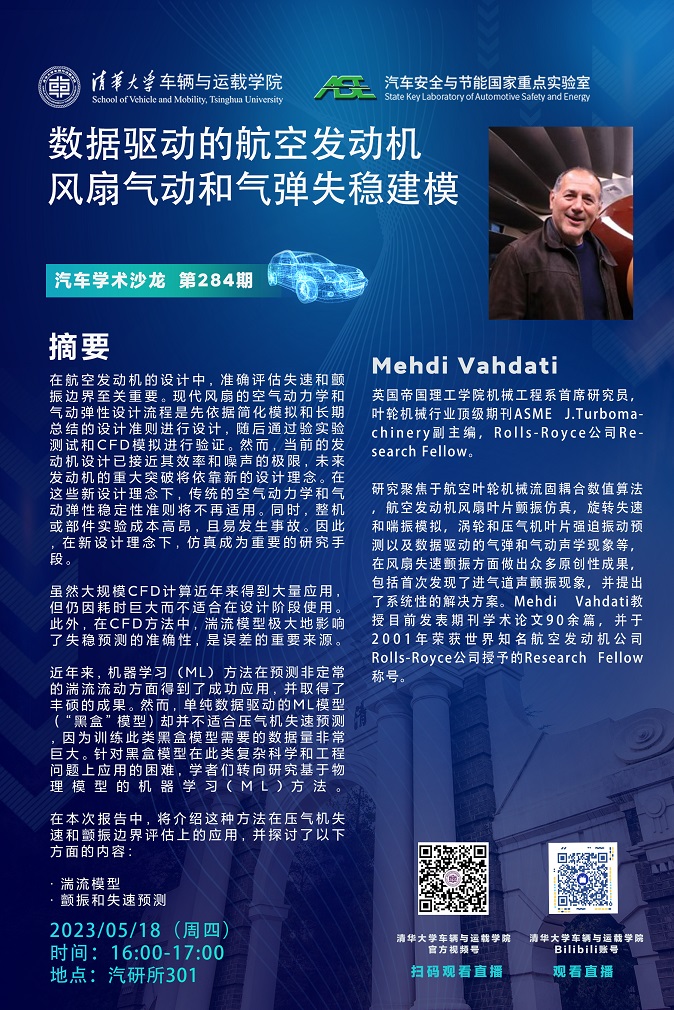
|












