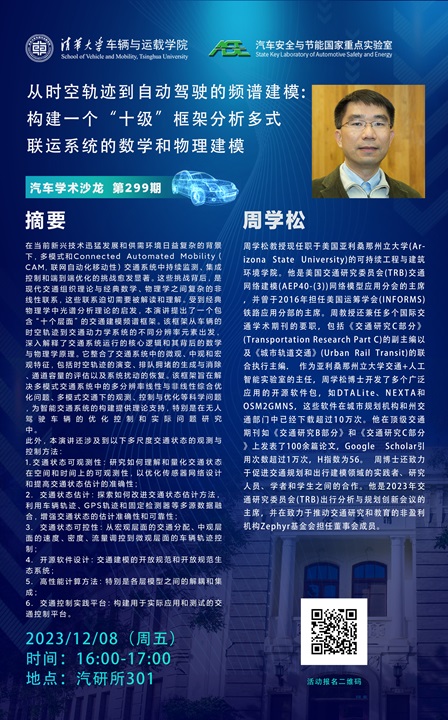
周学松 简介 周学松教授现任职于美国亚利桑那州立大学(Arizona State University)的可持续工程与建筑环境学院。他是美国交通研究委员会(TRB)交通网络建模(AEP40-(3))网络模型应用分会的主席,并曾于2016年担任美国运筹学会(INFORMS)铁路应用分部的主席。周教授还兼任多个国际交通学术期刊的要职,包括《交通研究C部分》(Transportation Research Part C)的副主编以及《城市轨道交通》(Urban Rail Transit)的联合执行主编. 作为亚利桑那州立大学交通+人工智能实验室的主任,周学松博士开发了多个广泛应用的开源软件包,如DTALite、NEXTA和OSM2GMNS,这些软件在城市规划机构和州交通部门中已经下载超过10万次。他在顶级交通期刊如《交通研究B部分》和《交通研究C部分》上发表了100余篇论文,Google Scholar引用次数超过1万次,H指数为56。 周博士还致力于促进交通规划和出行建模领域的实践者、研究人员、学者和学生之间的合作。他是2023年交通研究委员会(TRB)出行分析与规划创新会议的主席,并在致力于推动交通研究和教育的非盈利机构Zephyr基金会担任董事会成员。 英文题目:From Space-time Trajectory to Connected Automated Mobility Modeling Spectrums: A 'Ten Levels' Framework to Understand the Mathematics and Physics Underlying the Multimodal Transport System 中文题目:从时空轨迹到自动驾驶的频谱建模:构建一个“十级”框架分析多式联运系统的数学和物理建模 英文摘要: In this talk, I present a 'Ten Levels' framework to address the evolving challenges in multimodal and Connected Automated Mobility (CAM) transportation systems amidst new technological advancements and complex supply-demand scenarios. This framework, inspired by spectral analysis in classical physics, systematically explores the intricate connections between modern transportation theory and the fundamentals of mathematics and physics. It ranges from analyzing the minute details of vehicle space-time trajectories to the overarching dynamics of traffic systems, offering insights into the operation and optimization of these systems. The aim is to illuminate the intertwined relationships between contemporary transportation theories and classical scientific principles. This initiative is more than academic; it's a critical step in tackling real-world transportation challenges. The 'Ten Levels' framework is designed to dissect and reevaluate core principles, providing a comprehensive understanding from micro to macro aspects of transportation. Emphasizing the need for innovative approaches, this perspective integrates emerging technologies, nonlinear dynamics, and advanced optimization strategies. By drawing parallels across scientific disciplines, it seeks to deepen understanding and inspire novel solutions in intelligent transportation and unmanned vehicle systems. This dialogue aims to share knowledge, stimulate thought, and encourage collaborative exploration. Through interdisciplinary and cross-generational exchanges, we aim to enhance our collective understanding and innovation capabilities in multimodal transportation systems. 中文摘要:在当前新兴技术迅猛发展和供需环境日益复杂的背景下,多模式和Connected Automated Mobility(CAM, 联网自动化移动性)交通系统中持续监测、集成控制和端到端优化的挑战愈发显著。这些挑战背后,是现代交通组织理论与经典数学、物理学之间复杂的非线性联系,这些联系迫切需要被解读和理解。受到经典物理学中光谱分析理论的启发,本演讲提出了一个包含“十个层面”的交通建模频谱框架。该框架从车辆的时空轨迹到交通动力学系统的不同分辨率元素出发,深入解释了交通系统运行的核心逻辑和其背后的数学与物理学原理。它整合了交通系统中的微观、中观和宏观特征,包括时空轨迹的演变、排队拥堵的生成与消除、通道容量的评估以及系统扰动的恢复。该框架旨在解决多模式交通系统中的多分辨率线性与非线性综合优化问题、多模式交通下的观测、控制与优化等科学问题,为智能交通系统的构建提供理论支持,特别是在无人驾驶车辆的优化控制和实际问题研究中。 此外,本演讲还涉及到以下多尺度交通状态的观测与控制方法: 1. 交通状态可观测性:研究如何理解和量化交通状态在空间和时间上的可观测性,以优化传感器网络设计和提高交通状态估计的准确性。 2. 交通状态估计:探索如何改进交通状态估计方法,利用车辆轨迹、GPS轨迹和固定检测器等多源数据融合,增强交通状态的估计准确性和可靠性。 3. 交通状态可控性:从宏观层面的交通分配、中观层面的速度、密度、流量调控到微观层面的车辆轨迹控制。 4. 开源软件设计:交通建模的开放规范和开放规范生态系统。 5. 高性能计算方法:特别是各层模型之间的解耦和集成。 6. 交通控制实践平台:构建用于实际应用和测试的交通控制平台
|












